Four rounds of work on the tap-to-command prototype since the last changelog, all live now at
orbit2d.co. Two of them are about the game finally introducing itself,
and two are about giving a long session somewhere to go.
A title screen that tells the truth
Opening the prototype used to drop you straight onto a frozen crash site with no idea what you were
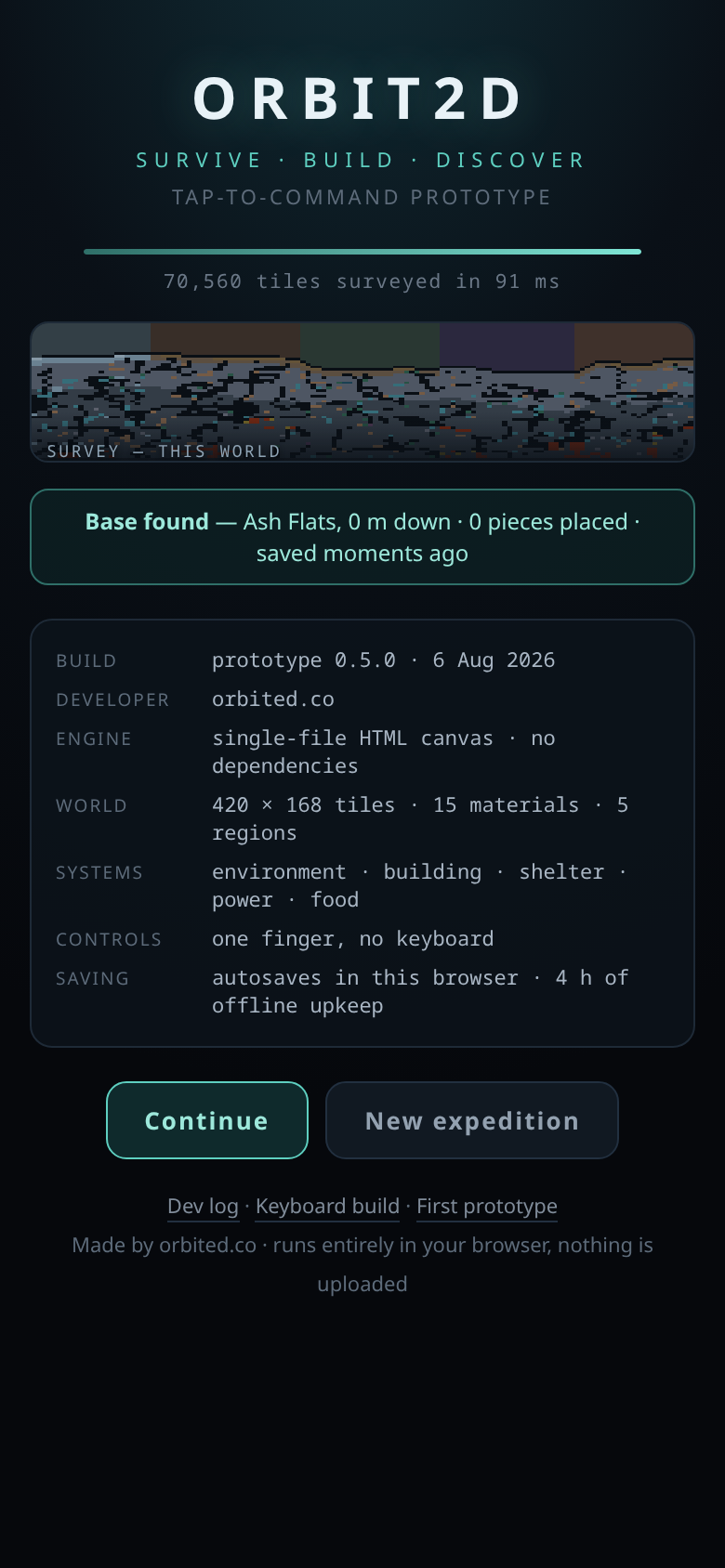
looking at. There is now a proper loading screen: the title, the tagline, and a strip of the
real minimap — not artwork, but the world that has just been generated for you, so no two
loads show quite the same ridge line. The load line is honest too: it counts the tiles actually
surveyed and the milliseconds it actually took.
Underneath it, the details you would want before spending an hour in something: build number and
date, the engine, the size of the world, the systems that exist, that it plays with one finger, and
that it saves in your browser and uploads nothing. If you have played before it reads your save and
tells you where you left off — “Base found — Fungal Basin, 12 m down · 34
pieces placed · level 9” — and offers Continue or a new
expedition.
The camera now goes where you are looking
A small thing that was quietly ruining the game. Switching between the two crew members moved the
selection but not the view, so half of every swap was spent hunting for whoever you had just picked.
Selecting anyone now brings the camera to them: a roughly one-second glide if they are nearby, an
instant cut if they are across the map, because a slow pan over 300 tiles is worse than a jump. They
get a one-second halo so your eye finds them, and a line telling you where they are —
“Vale — Crystal Fault, 31 m down”.
Thirty levels, earned by working
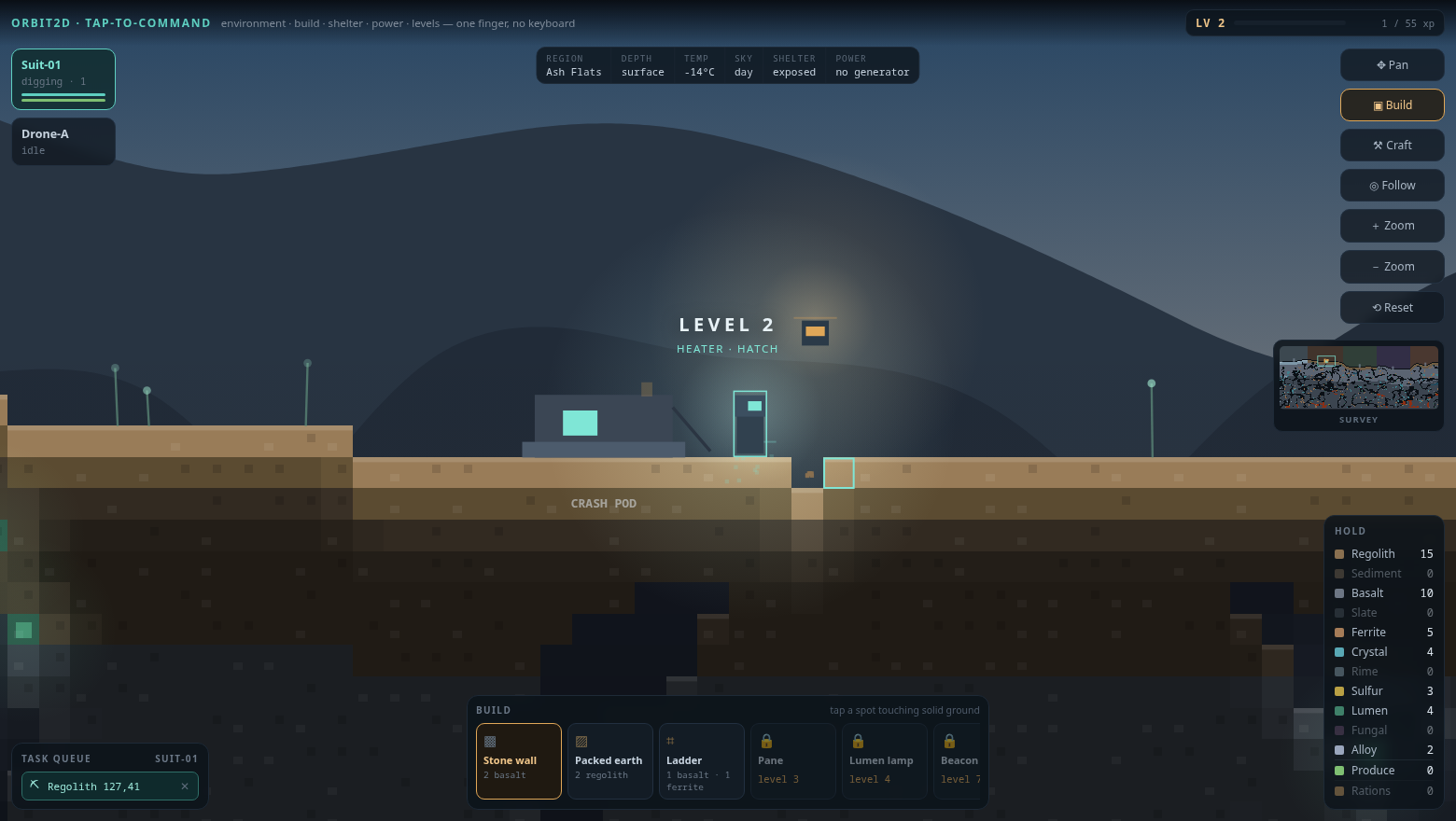
Experience comes from doing the two things the game is about: digging and building. A tile of
regolith is worth 1, basalt 2, slate and ferrite 3, crystal 5, alloy 6. A wall or a ladder pays 5, a
lamp or a heater 8, a bench or a beacon 12, a machine 15. Fitting an upgrade pays 60, and finding one
of the landmarks out in the world pays 120.
Two rules keep it honest. Salvaging something you built pays nothing back, and any given tile pays
its build experience only once ever — so building and unbuilding the same wall in a corner is
worth exactly zero. The curve runs from 45 experience for level 2 to about 10,000 for level 30,
roughly 57,500 for the whole climb.
Ranks are what hand you the game a piece at a time. You start with walls, packed earth and a
ladder; the heater and hatch arrive at 2, a window at 3, lamps at 4, the craft bench at 5, the beacon
at 7, the generator at 9, the planter at 11 and the galley at 12, with the seven upgrades threaded
between them. Locked rows stay visible in the build palette with the level they need, because a
prototype should show you what it is saving for you.
Talents: a choice every fifth level
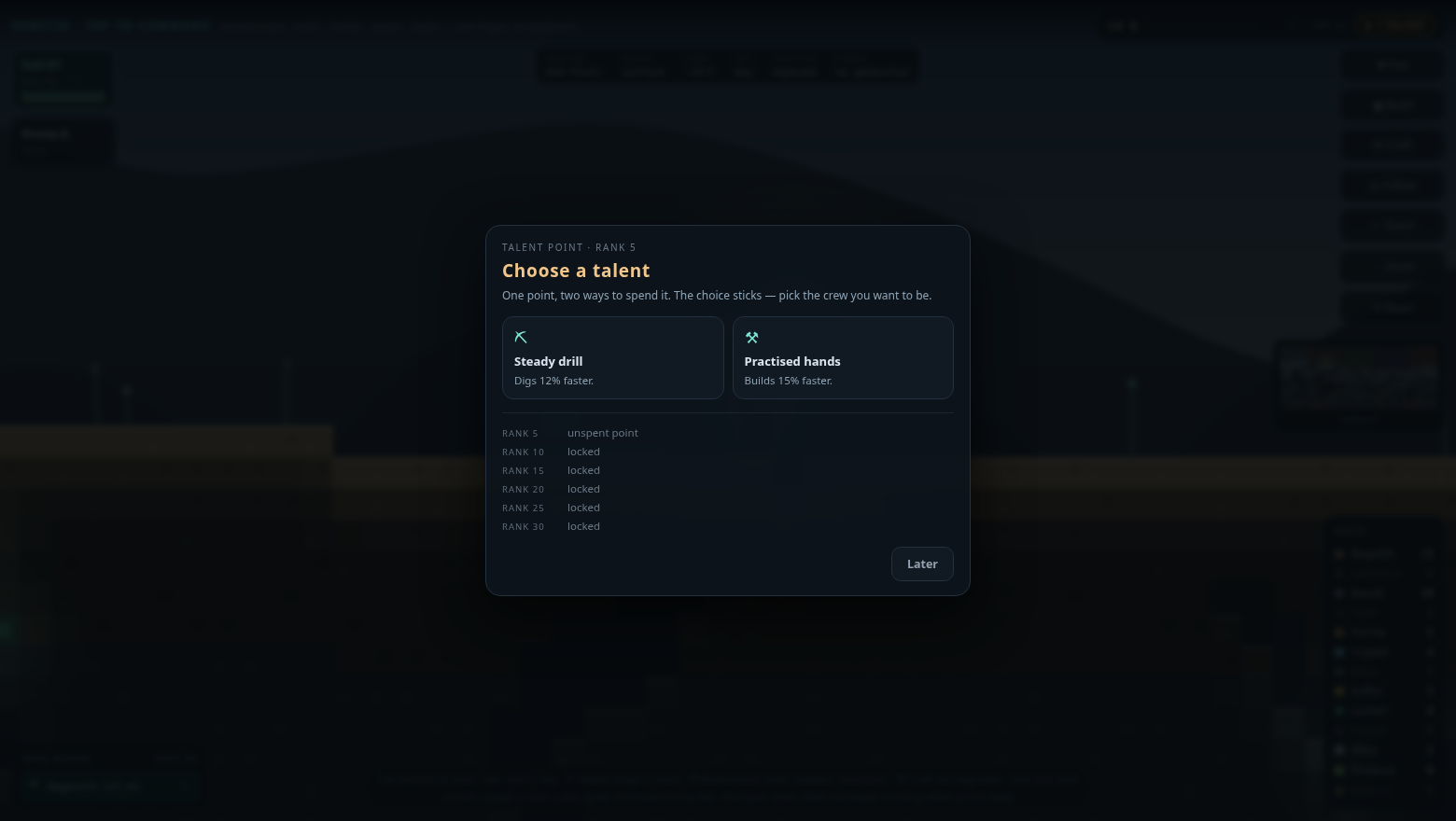
Every fifth rank now hands over a talent point and two ways to spend it, and the choice sticks.
- Rank 5 — Steady drill (dig 12% faster) or Practised hands (build 15% faster)
- Rank 10 — Rich seams (one dug tile in four yields a second unit) or Long legs (crew moves 12% faster)
- Rank 15 — Cold discipline (cold drains 15% slower) or Bright optics (headlamps reach two tiles further)
- Rank 20 — Deep cut (another 15% dig) or Site foreman (another 18% build)
- Rank 25 — Fuel sense (generators burn 30% slower) or Green thumb (planters grow 30% faster)
- Rank 30 — Warm blood (cold 25% slower, and sealed rooms hold a little more heat) or Expedition certified (10% faster at everything)
The pairs are deliberately not six flavours of the same bonus: miner against builder, loot against
mobility, survival against sight, power against food, and at the top a specialist capstone against a
generalist one. Two players at level 20 should be able to describe their run differently.
The picker lifts about a second after the level-up banner, dimming the world so it reads as a
moment rather than a notification. Dismiss it with Later and the point stays owed — the
rank badge keeps a pulsing star until you spend it, and tapping the badge any time shows the whole
tree with your picks marked.
Where to find it
The prototype is at orbit2d.co. The earlier keyboard build is
still at orbit2d.co/build, and the first tap prototype at
orbit2d.co/lab/tap. Next on the list: threats, and something
to defend against them.