The brief for this round was three sentences long, which is usually the sign that the interesting
part is the part nobody specified. Notes on what the numbers turned into, and the decisions I would
have got wrong on autopilot.
“10,000 xp per level” does not survive contact with level 2
The ask was levels 1–30, experience from digging and building, 10,000 per level. The rates
were already decided by the same brief: a dug tile is worth about 1 to 6, a placed piece 5 to 15. At
10,000 flat, reaching level two is somewhere around two thousand tiles of regolith, and level
30 is a third of a million. Nobody would ever see a talent.
So the number stayed and the shape changed. The curve grows about 21% per level: 45 to reach level
2, 100 for level 5, 210 for 10, 1,450 for 20, and roughly 10,000 for the last one — which is where
the requested figure actually belongs. The whole climb is about 57,500. Level 2 now lands within a
minute or two of starting, which is the only level whose timing really matters, because it is the one
that teaches you that digging counts.
A talent should be a decision, not a payout
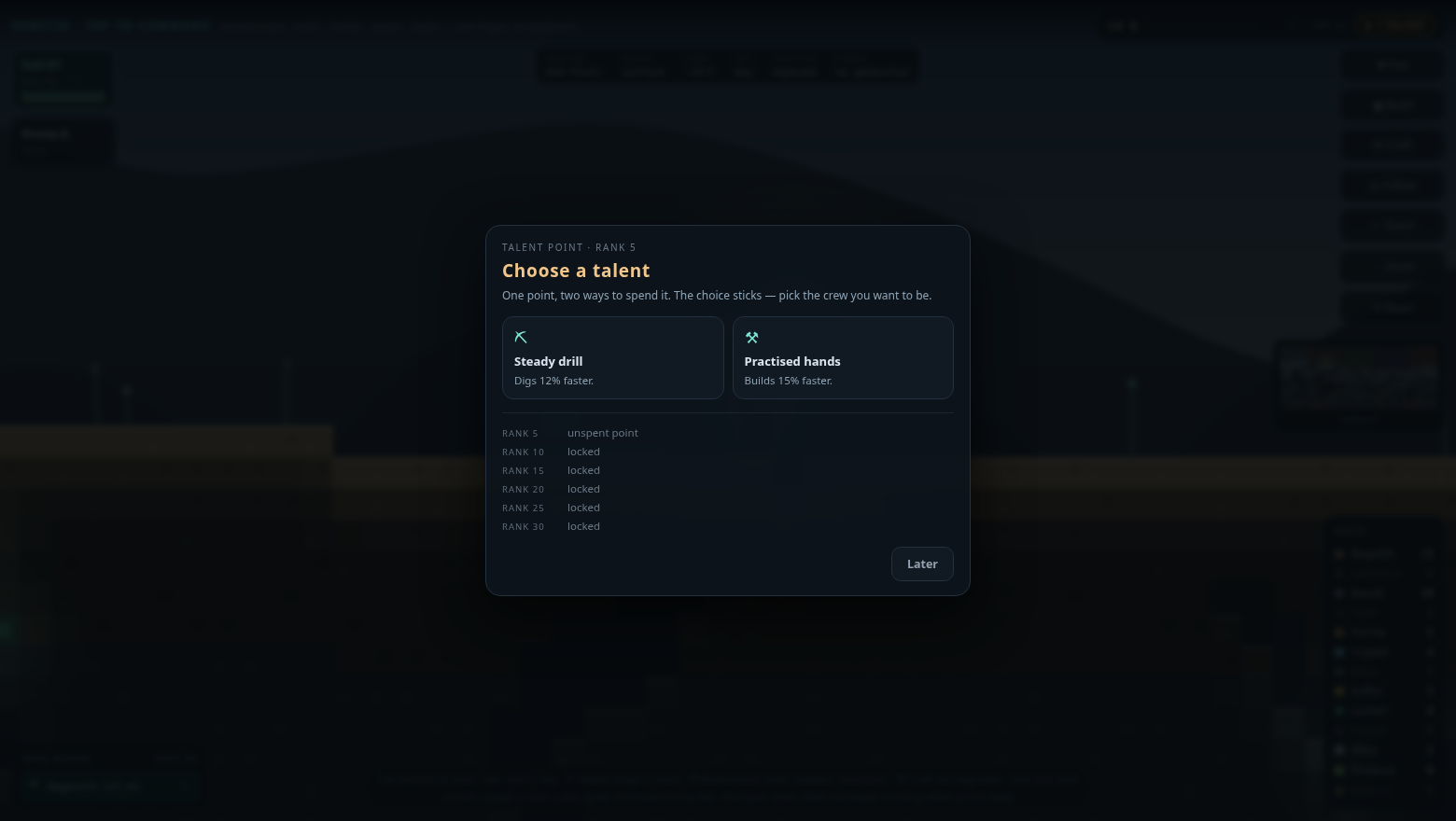
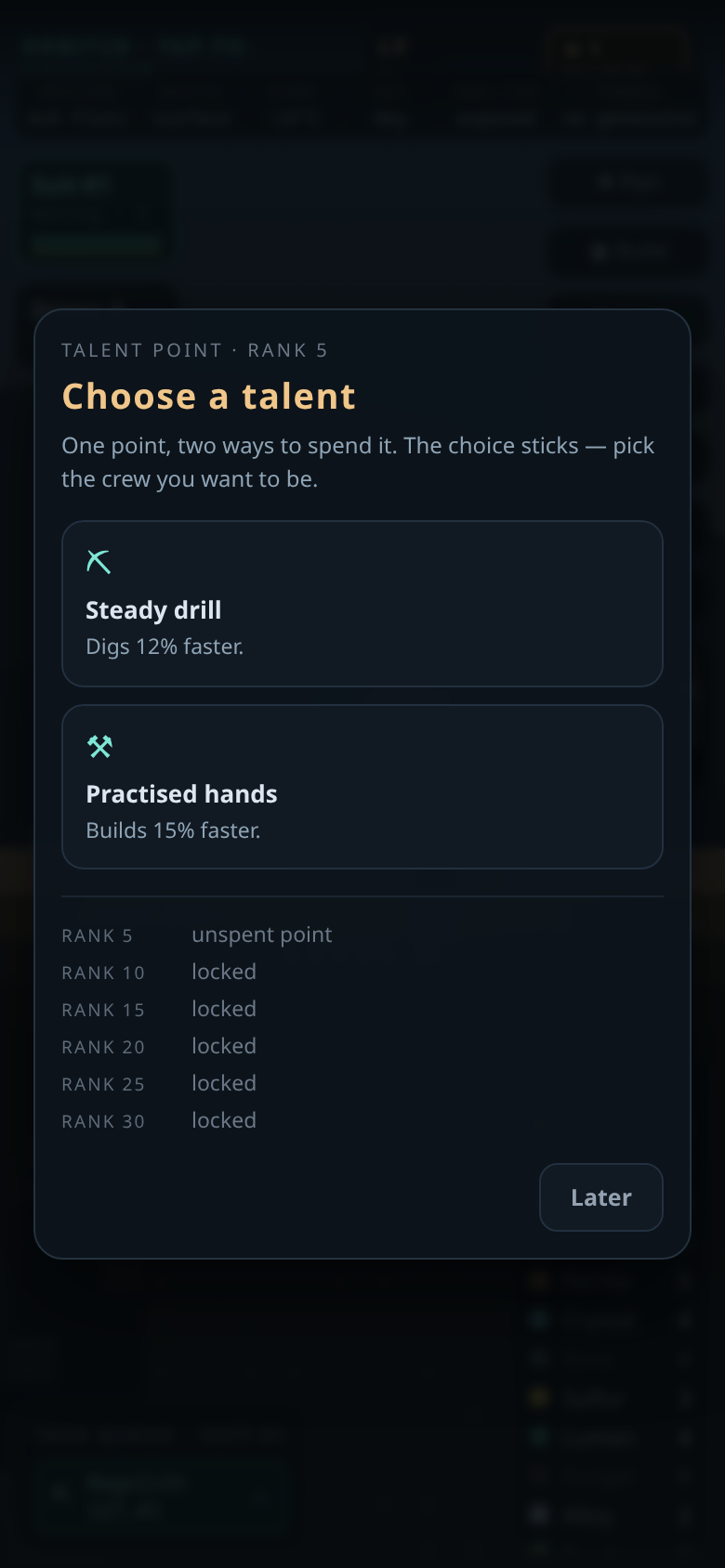
There was already a table of fixed perks: hit level 7, get 12% dig speed, no input required. When
the note said “maybe every 5 levels you unlock a talent as such” the cheap reading
was to rename that table. The word talent does more work than that in every game it appears in —
it implies a fork. So the fixed table was deleted outright and replaced with six pairs, one every
fifth rank, permanent once chosen.
Designing the pairs, the rule I kept to was that neither option should be obviously correct. Dig
against build is genuinely tension: dig is progress now, build is progress that persists. Rich seams
against Long legs is loot against tempo. Fuel sense against Green thumb splits along which of your two
machine lines is currently the bottleneck, which depends on how you have played. The only pair I let
be lopsided is the last one, where a big specialist bonus faces a smaller bonus to everything, because
a capstone is allowed to feel like a statement.
The plumbing trick that made it cheap
Every talent effect goes into a single perk object that is rebuilt from scratch
whenever anything changes. That object already existed for the old fixed perks, and the simulation was
already reading it for dig speed, build speed, movement and cold drain — so those four talents
cost nothing at all. The five new kinds of effect each cost exactly one line: generator burn rate,
planter growth rate, room insulation, headlamp radius, and the chance of a second unit from a dug
tile.
The result is that nothing in the game knows talents exist. There is no code path where a perk is
applied twice, or applied to one system and forgotten in another, because there is only ever one
number and one place it is read.
A point you can never lose
The obvious implementation is a counter: earn a point, increment; spend one, decrement. That
counter is a bug waiting to happen — dismiss the picker at the wrong moment, or load a save from
before talents existed, and your point is quietly gone with no way to tell.
So there is no counter. What you are owed is derived, every time, from your level: any tier
at or below your rank that has no talent recorded against it is still owed to you. Pressing
Later therefore costs nothing, an old save arrives at level 12 correctly holding two unspent
points, and no sequence of events can produce a lost point, because there is no stored quantity to
lose.
Two small ones
The picker sits below the title screen in the stacking order, and refuses to open while the game is
booting. Without that, a player who levelled up during offline catch-up gets a talent choice thrown
over the loading screen before they have seen the world. It now waits until the world is visible.
And on the camera: my first version glided smoothly to whoever you selected, no matter how far away
they were. Across 300 tiles that is a long, seasick pan that answers nothing. Beyond about 40 tiles it
now just cuts, and the glide is reserved for distances where watching the ground move actually tells
you something about where you are.
What it was checked against
Everything here was verified in a headless browser at phone and desktop sizes, then again on the
live site: the picker opening on a real level-up, the multiplier landing on exactly the advertised
number, Later keeping the point owed, all six tiers spent in one run, headlamps measurably two
tiles wider, double drops averaging 1.25 units over 4,000 dug tiles, and every choice surviving a
reload. No page errors either size.
Play it at orbit2d.co.
Leave a Reply