The question that started this round was a good one: is it worth making the world bigger? The honest answer was no. 420 columns is already more ground than a two-person crew can exhaust, and doubling it would only have added walking. What the game was short of was not space — it was reasons to start again.
So instead of one world twice the size, there are now twenty.
What a seed actually changes
A seed is not a decoration on the same map. It does three separate things.
First, it offsets every noise lattice in the generator. Terrain relief, cave worms, the deep chambers, the brine and magma pools, ore seams, lumen moss and surface flora all read from the same shifted lattice, so they change together and stay consistent with each other. One number moves the whole world.
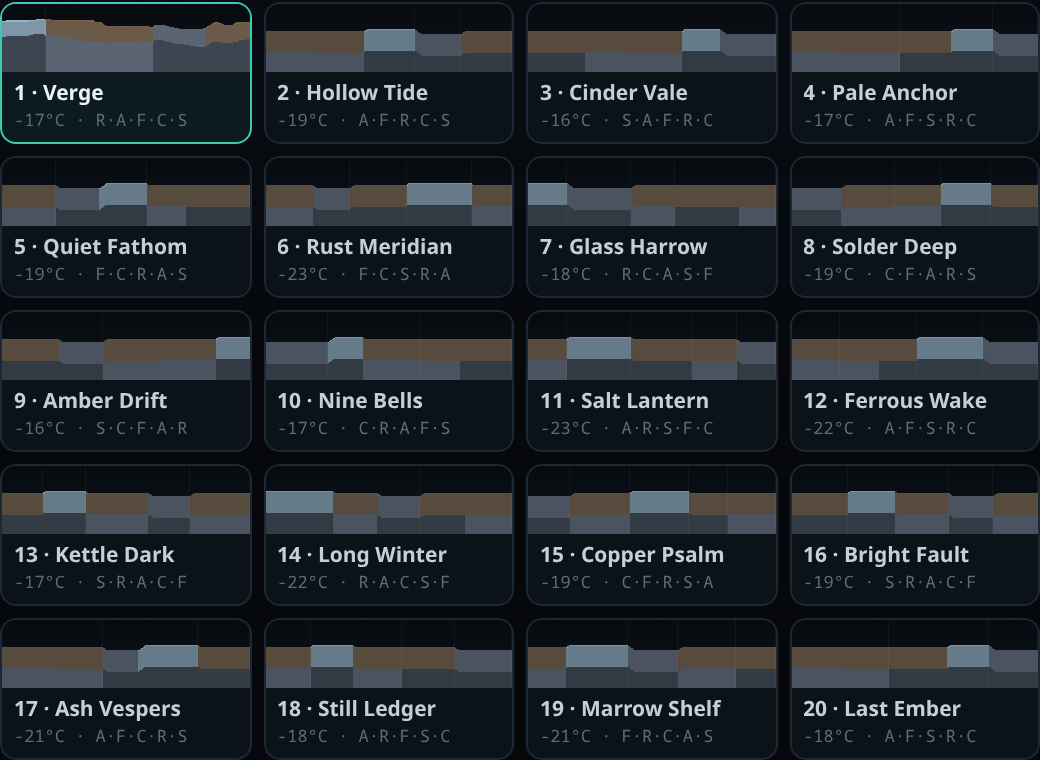
Second, it shuffles the regions. All five always appear — Rime Shelf, Ash Flats, Fungal Basin, Crystal Fault, Signal Ridge — but their order west to east and how much of the world each one owns are drawn from the seed, with a floor of 54 columns so no region gets squeezed into a token strip. On world 6 the Rime Shelf is 111 columns of ice in the east; on world 3 it is 65 columns wedged between the basin and the fault.
Third, the landmarks move with their regions. The Rime Geyser is always on the Rime Shelf and the Spore Grove is always in the Fungal Basin, because a landmark that turns up in the wrong biome stops meaning anything. They keep their homes and get jittered inside them.
The crash pod is placed with one rule I am fairly firm about: never on the Rime Shelf and never on the Signal Ridge. Landing at −58 °C with no shelter, no heater and no levels is not a start, it is a death. So the crash site rotates between the Ash Flats, the Fungal Basin and the Crystal Fault, which changes the opening of the game without making it unfair.
Twenty previews for 30 milliseconds
The obvious problem with a world list is that a world costs 70,560 tiles to generate. Twenty of those on the title screen would be a two-second stall for something you look at for a moment.
The fix is that a preview does not need tiles. The generator’s first pass computes 420 columns of surface height and strata depth, and that — plus the region layout — is enough to draw a recognisable cross-section. So the previews run the relief pass only: 420 columns instead of 70,560 tiles, twenty worlds profiled in about 30 milliseconds, and the strip at the top of the screen is the real shape of the world you are about to land on.
The full generator now runs when you pick a world, not when the page loads. That turned out to be the tidier design anyway: “New expedition” used to need a page reload, and now it doesn’t, because nothing has been built yet.
Twenty worlds means twenty bases
Each world has its own save slot, its own base, its own inventory and its own level, xp and talents. Starting world 7 does not touch your level 14 base on world 1. A save records which world it belongs to and refuses to open in any other, and a small index of what is in each slot lets the picker show “LV 12” on a card without parsing twenty 27 KB saves. The survey panel now names the world you are on, and tapping it takes you back to the list.
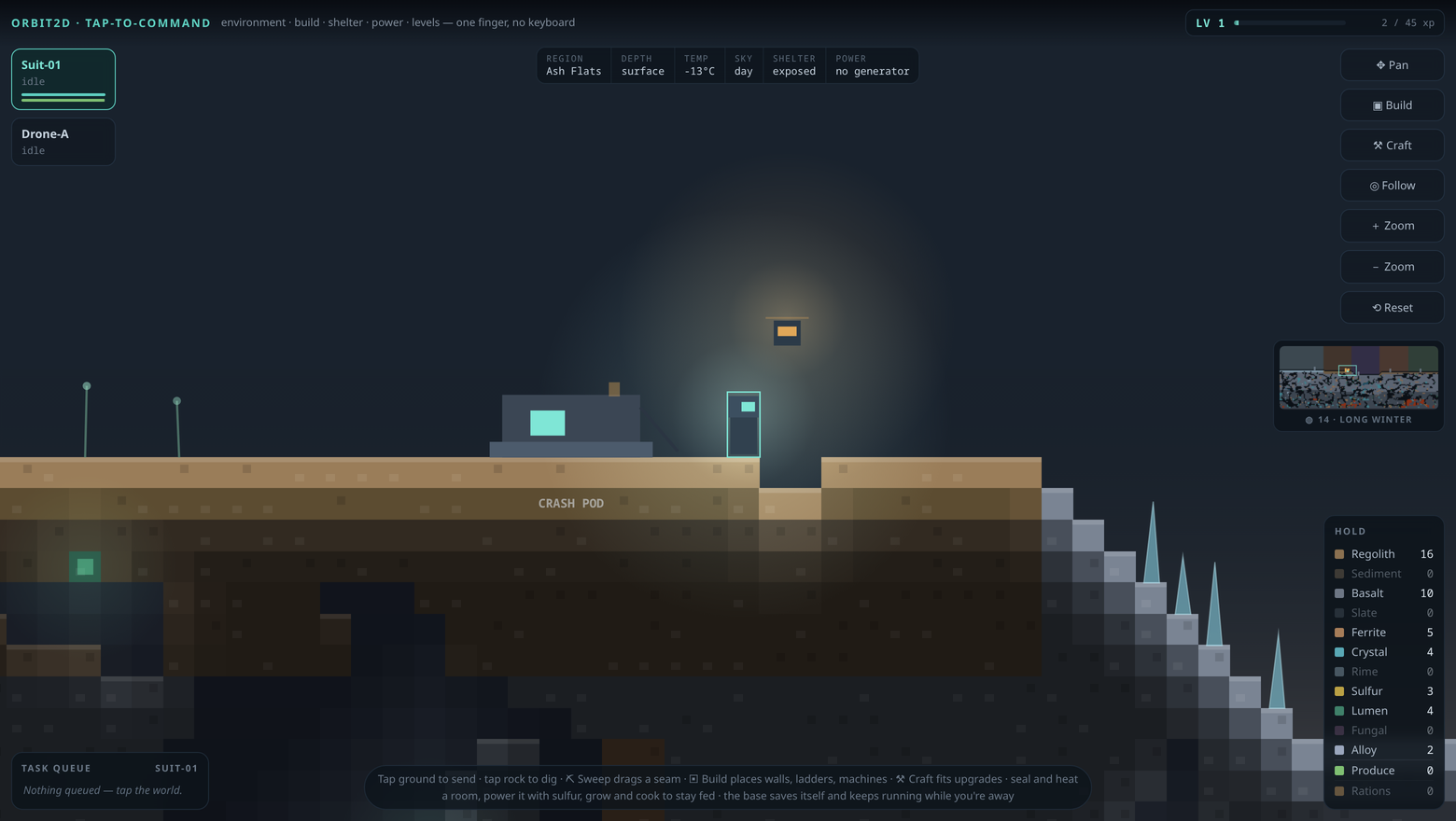
World 1 is called Verge, and it is deliberately untouched — its offset is zero and its region spans are hardcoded, so it generates exactly as it did before any of this existed. If you had a base there, it is still there, in the same rock.
Two bugs worth admitting
Deferring generation exposed a real one. The game autosaves when you close the tab — and with the title screen up, “the game” was an empty world of nothing but air. Open the page, close it without pressing anything, and you would come back to a cheerful “Base found” that dropped the crew into a void. Saving is now gated on a world actually existing.
The second one had been quietly live for a while. When a save was loaded, the generator fuel and crop growth tables were reassigned rather than refilled, which left every other reference pointing at the old object. The visible symptom was that offline progress after a reload under-reported what your planters had grown. Refilling in place fixed it, and the away summary now reads honestly: “33 grown · 17 cooked · 40 sulfur burned”.
What this does and doesn’t fix
To be straight about it: twenty worlds is replay value, not depth. The hole I pointed at before this round is still there — every unlock in the game lands by level 18, so levels 19 to 30 cost about four-fifths of the total xp and hand out three talent cards. Variety in the ground you start on does not fill the back half of the curve. Deep strata and late-game machines are still the next job.
Play it here — twenty worlds, one finger, no keyboard.
Leave a Reply