Everything else in this game has been getting deeper for weeks — fifteen materials, sealed
rooms that hold heat, generators that burn sulfur, twenty seeded worlds, an ending that reads your
colony back to you. And the whole time, the person doing all of that work was a rectangle with a
lighter rectangle for a helmet and a single line that swung back and forth when it was supposed to
be mining. You spend hours watching that thing. It was the least convincing object on the screen.
So the crew got a skeleton.
Not a sprite sheet — a rig
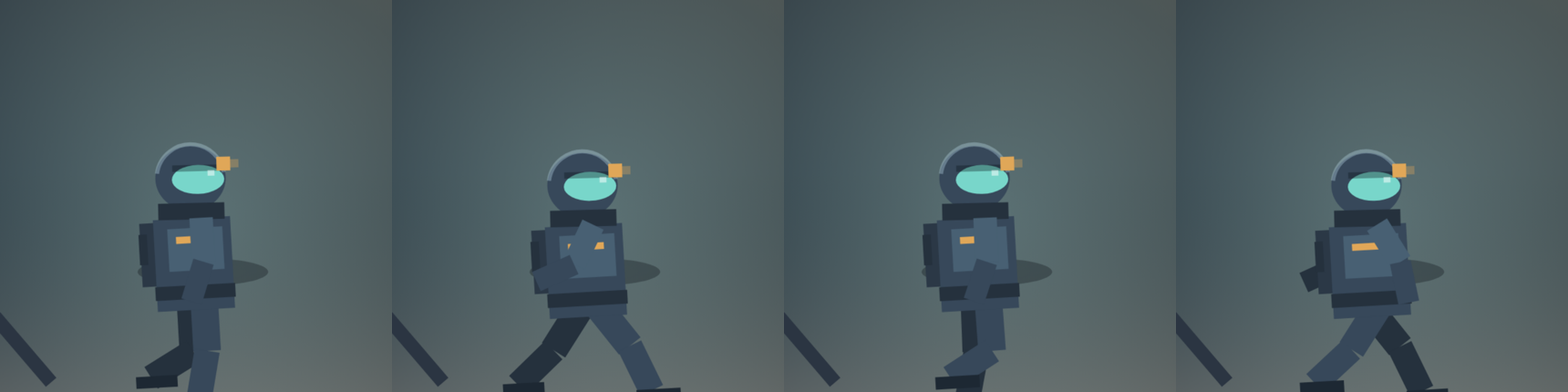
There are no animation frames anywhere in this game and there is still no image file. Each crew
member is a jointed figure solved and drawn every frame: hips, knees, shoulders, elbows, a helmet
on a neck ring, a life-support pack, boots. Two-segment limbs, each with an angle at the joint,
posed differently depending on what the suit is actually doing. The hand is a real position in
space, which is why the pick is held now instead of being a line sticking out of a torso.
Doing it procedurally rather than as artwork buys something specific: the animation can respond
to the simulation. Which brings me to the detail I am most pleased with.
The walk is driven by distance, not by a clock
The obvious way to animate a walk is to swing the legs on a timer. It looks fine until the
character’s speed changes — and in this game it changes constantly, because cold slows the crew
down, hunger slows them down, and the servo upgrade speeds them up. A timer-driven walk in those
conditions produces the thing every player notices without being able to name it: feet that skate
along the ground like the figure is on ice.
So the stride phase advances with distance covered. Every frame the rig
measures how far the suit actually moved and adds that to its gait. One full stride per 1.05 tiles,
whatever the speed. A freezing, starving colonist trudges; a fed one with servos strides; the feet
stay stuck to the floor in both cases, because the cycle is a function of the ground, not the
clock.
Vertical movement is watched separately, which is how the rig knows it is on a ladder — the
legs go to a reaching climb and the arms go over the head. That one needed a decaying accumulator
rather than a simple test, because the pathfinder moves the crew a whole tile at a time and any
given frame usually shows no vertical motion at all.
The pick swings where the rock is
The old mining animation swung the same way no matter what was being dug, which looked absurd
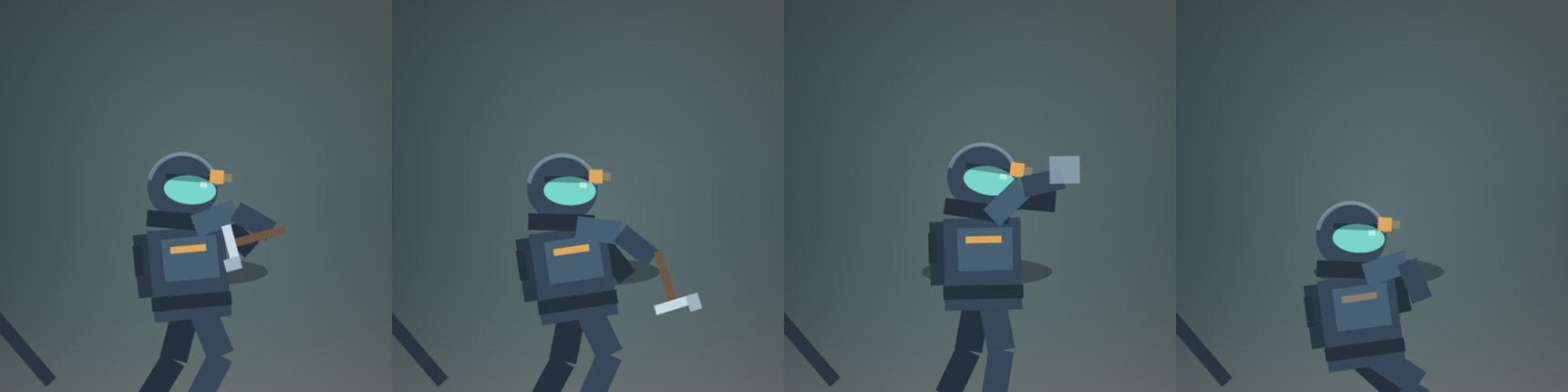
in the most common case in the whole game: cutting a shaft downward. So the head now
tilts toward the tile being worked, and the same value aims the swing — chopping down between the
boots, sideways into the wall, or overhead into the ceiling, with the stance and the lean changing
to match. Crew also turn to face what they are working on, which they somehow never did before;
face was only ever set while walking.
The rest of the poses: hoisting a panel into place while building, a welding flare at the craft
bench, a ration lifted to the helmet port while eating, and knees up and arms crossed while
huddling in the cold. Idle is a pose too — breathing, weight on one leg, an occasional glance
around, and now and then a check of the forearm display. Standing still is where a character
either looks alive or looks like furniture.
The bug that taught me the useful rule
My first walk cycle floated. Not obviously — about a third of a tile of air under the boots,
enough that it looked like the suit was gliding rather than walking. The cause is geometric and
completely predictable in hindsight: when you bend a knee, the leg gets vertically shorter, so a
rig pinned at the hips lifts its feet off the floor.
The fix is a rule rather than a fudge. After posing, the rig works out where the lowest boot
has ended up and shifts the whole body down so that boot is exactly on the tile. Every pose is
grounded for free — the braced digging stance, the huddle, the crouch at the bench — and I never
have to hand-tune an offset per pose again. It is switched off in one place only: on a ladder,
where the feet are supposed to be in the air.
Small things that do the most
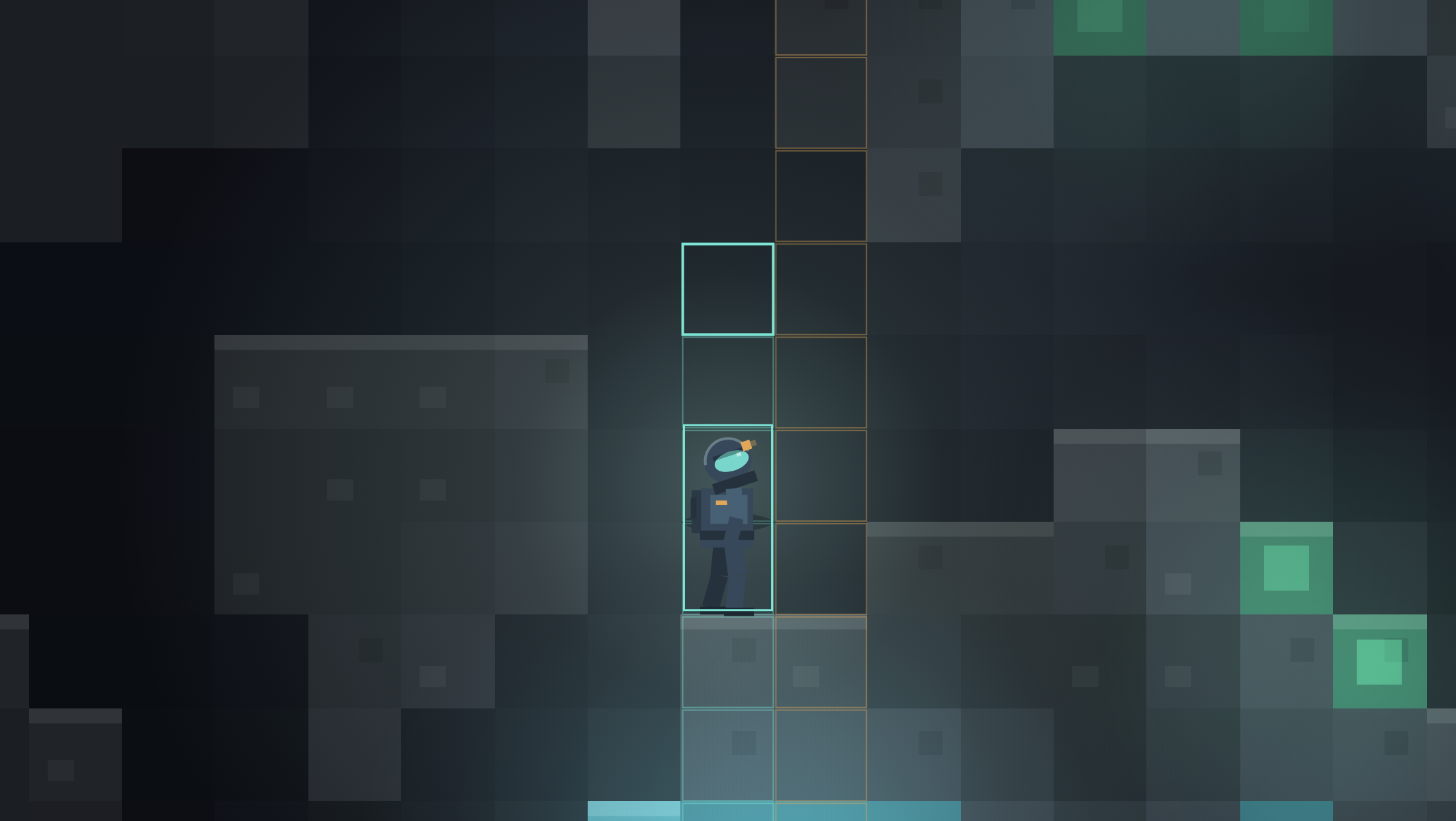
- Boots kick dust — in the colour of whatever material they are walking on.
- The helmet fogs. Breath puffs when the air is below freezing, faster while
huddling. It is the clearest read on “this room is not warm yet” the game has ever had. - Chips fly off the rock at the bottom of each swing, tinted by the seam.
- The chest strip dims as warmth drops, and the visor starts to flicker under
30%. You can now see a colonist is in trouble from across the map. - Contact shadows that fade with height, so nobody hovers.
- The drone is a quadrotor: booms, two ducted fans with the blades blurred, a
tilt into its direction of travel, a pulsing sensor eye and a grabber that extends when it works.
All of it costs nothing measurable — a locked 60 fps on desktop and on a 390-wide phone
viewport, checked live — and it added nothing to the save format, because the rig state is
derived rather than stored.
Live now at orbit2d.co as v0.7.2. Zoom in and watch them
work; that was the entire point.
Leave a Reply