The ending was the last thing missing. Last week the game got nine objectives and nine
recoverable log entries, which gave it a spine and a reason to dig — but the final beat was a
piece of writing that said the same words to everybody. A hundred hours of colony and a
twenty-minute sprint to the ridge finished identically. That is the one place a survival builder
can least afford to stop paying attention.
So the ending does not tell you anything now. It reads you.
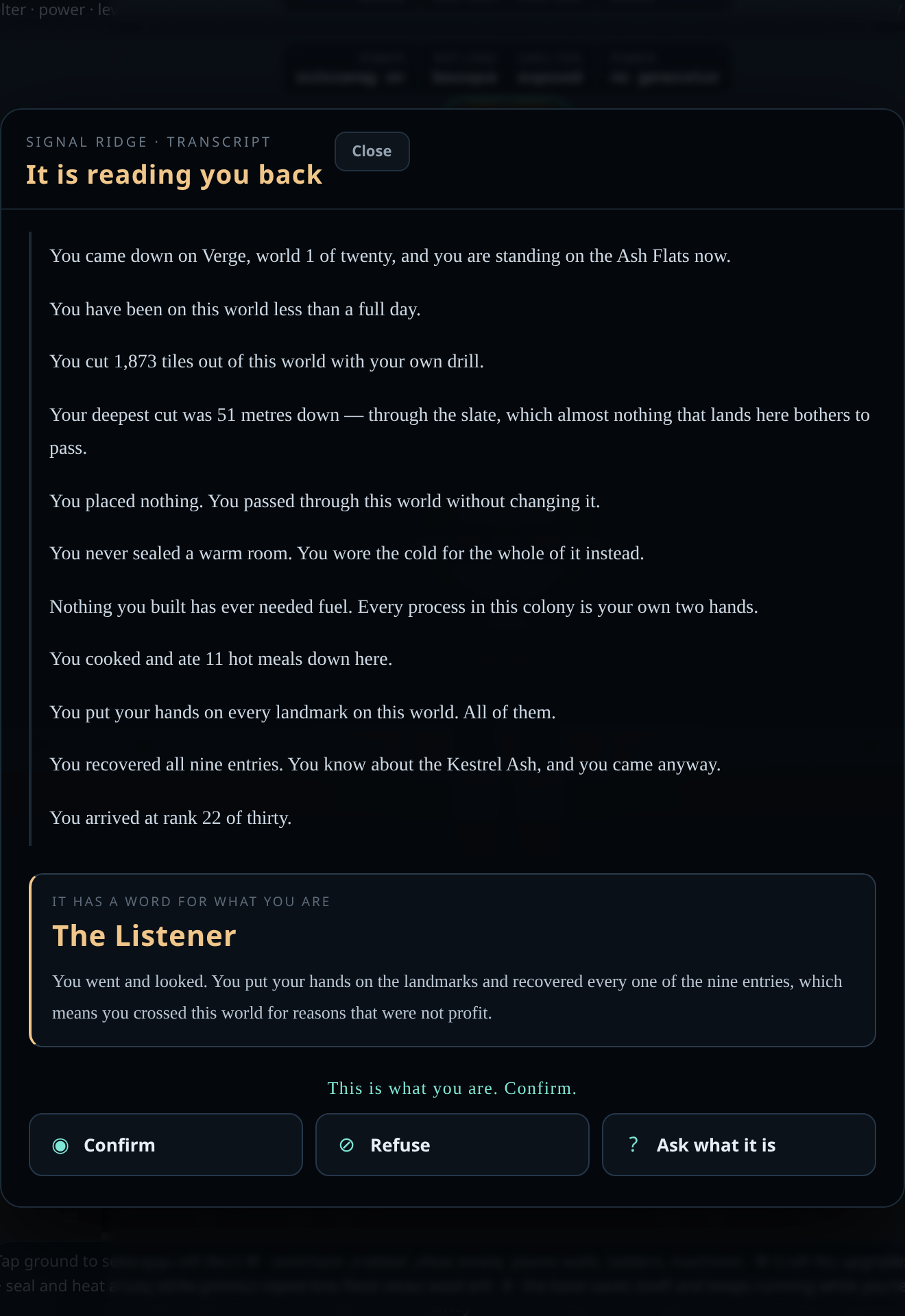
Everything on that screen is measured
When you reach the monolith the game takes one honest snapshot of the colony: tiles cut, pieces
laid and what kind, how many distinct sealed rooms you are actually holding above freezing,
whether a generator is running and how many machines draw from it, meals cooked, landmarks
reached, entries recovered, talents chosen, days survived, depth, rank. Nothing on the list is a
hidden counter the player could not already see on the HUD — it is all either counted off the map
at that moment or a number the interface has been showing you the whole game.
Then it reads them back one line at a time, and this is the part I care about: what you
never built gets a line too.
You never sealed a warm room. You wore the cold for the whole of it instead.
Nothing you built has ever needed fuel. Every process in this colony is your own two hands.
You came straight here. You looked at nothing else on the way.
An ending that only lists achievements is a trophy cabinet. The absences are what make it feel
like something was paying attention, and they cost nothing to write — every positive line already
needed a fallback branch for the case where the number is zero. I just refused to make the
fallback bland.
It has a word for what you are
Underneath the playback, the colony is scored on six axes — depth, shelter, industry, food,
exploration and sheer scale — each measured against what a thorough run of that kind looks like
rather than against the other five. The strongest one names you: The Deep Hand, The
Sealed Room, The Current, The Long Table, The Listener, The
Builder.
Two of the seven verdicts are not archetypes at all. Score respectably on every axis
and it declines to reduce you to one thing — you get The Colonist, because no part of the
colony was neglected enough to be the headline. Sprint to the ridge having built almost nothing
and you get The Passer-Through, which tells you plainly that the thing reading you back
has very little to read. Neither is a scolding and neither is a score. They are descriptions, and
the game earns the right to make them because it can point at the numbers.
Then it asks, and you answer
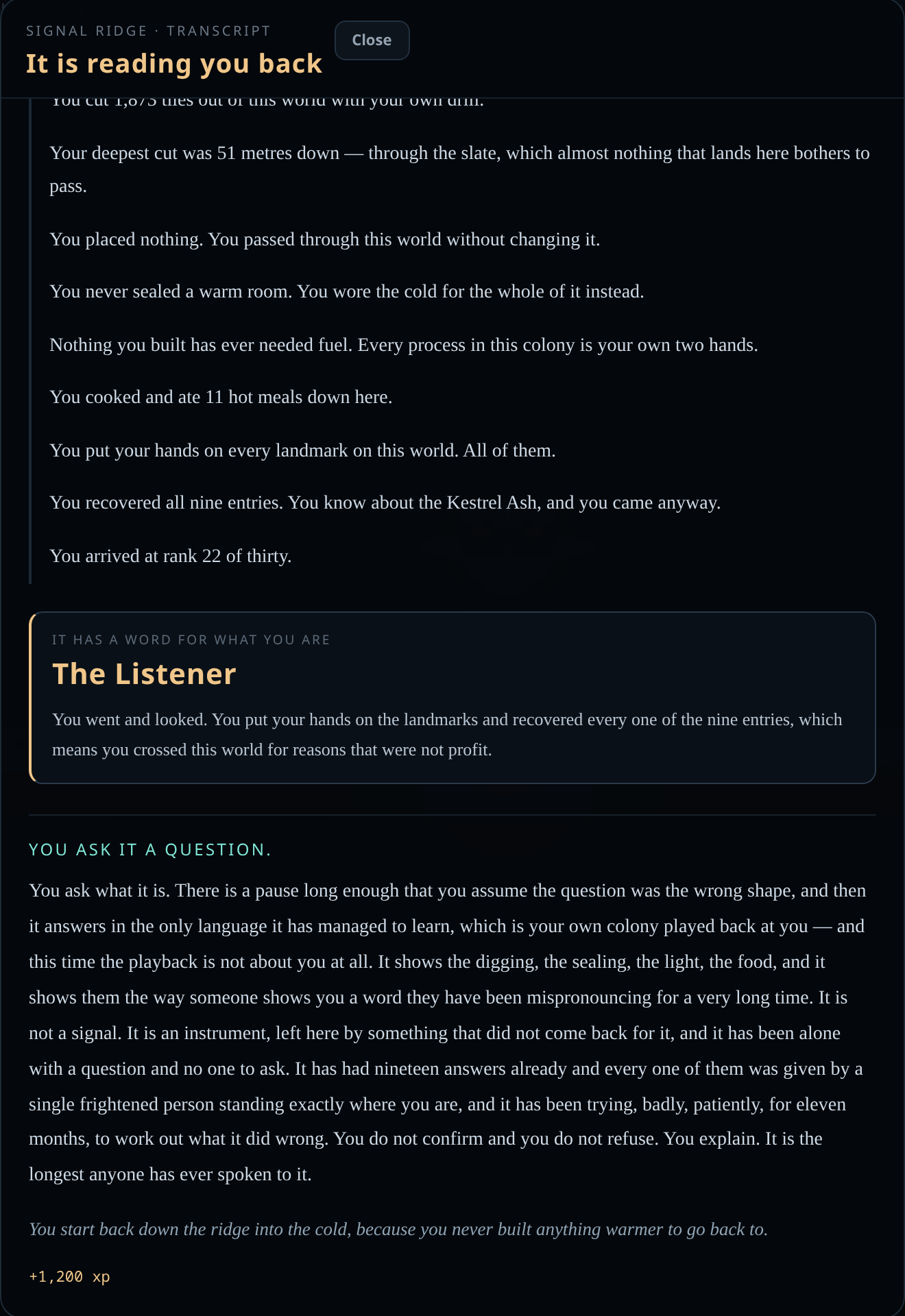
The transcript ends where the story has been pointing since the first survey note: This is
what you are. Confirm.
Three answers, each a written passage, none of them the correct one.
Confirm and the pattern stops — not fades, stops — and the gap it had been
holding open in its own signal turns out to have been your size. Refuse and you
tell it that every line of the transcript is true and that is exactly the problem: it read you as
finished, and a colony is a thing that is not finished. It goes quiet for fifty-one seconds, which
is the length of its own cycle and possibly the only joke it knows, and then resumes — listening
rather than calling, waiting for a signal you will send when you are ready to say what you are.
Ask what it is and you get the answer the whole game has been arranged around: it
is not a signal, it is an instrument, left here by something that did not come back for it, and it
has had nineteen answers already — every one given by a single frightened person standing exactly
where you are. It has been trying, badly and patiently, for eleven months, to work out what it did
wrong.
All three pay the same reward, because I do not want anyone opening a wiki to find out which
ending is the good one. And whichever you pick, the closing line is drawn from your colony too: if
you never sealed a warm room, you start back down the ridge into the cold, because you never built
anything warmer to go back to.
Small things that mattered more than they should
The transcript is deliberately plainer than the rest of the interface — serif text, one line at
a time, no glow — because it is a document, not a HUD. There is a Skip for anyone who has read it
before. It is saved with the snapshot it was generated from, so re-reading it from the signal log
months later shows the colony as it was at the ridge, not as it is now.
And two ordering bugs I only found by looking at the thing rather than at the test output: the
ending could re-open over itself if the last objective completed while it was already on screen,
and because it sits above every other panel it could bury an unspent talent point’s picker
underneath it. Modals that arrive on timers need to check the world again at the moment they fire,
not only at the moment they were scheduled.
Where this leaves the prototype
Twenty seeded worlds, thirty ranks with a talent every fifth, shelter and power and food,
persistent saves with offline progress, nine objectives, nine log entries, seven verdicts and
three endings — and a feedback form on the title screen that reaches me within a couple of hours.
The story layer is done.
What it has not had is players who are not me. That is the next thing, and it is worth more
than another system: I will write better content knowing where real people actually got stuck.
Play it, answer the tone however you like, and tell me what dragged.
Leave a Reply