Twenty worlds went into the game a few versions ago and the maths behind them was honest enough:
each one is a seed, and the seed moves every noise lattice, shuffles the order of the five regions and
relocates the landmarks. No two were the same. But a player put it better than the changelog did:
they’re all pretty much the same. We need hot, cold, green.
They were right, and it is worth being precise about why. Variety of layout is not
variety of place. Every world had the same ice shelf, the same ash flats, the same
fungal basin, the same fault, the same ridge — in a different order, at a different width. Landing
somewhere new felt like walking into the same room with the furniture moved.
A climate is the layer above the seed
So there is now a second knob. Every world has a climate, and the climate decides
what kind of rock it is: how cold the whole world runs, which of the five regions dominates it, what
the sky and the weather do, what grows on the surface, and what the ground is generous with. The seed
still does everything it did. The climate decides what the seed is arranging.
There are seven, and one of them is the old baseline:
- Temperate — the original survey. Cold, workable, nothing trying especially hard
to kill you. - Glacial — ice most of the way round, rime everywhere, sulfur almost nowhere.
Sealing a room is the first thing you do rather than the fifth. - Volcanic — a rock that never finished cooling. Thick with sulfur, warm enough to
work in places, and the ash never settles. - Verdant — above freezing in the middle of the day, which on this survey counts as
paradise. The basin has taken over: fungal growth, lumen in the caves, food that nearly grows itself. - Arid — dry to the bone. No ice worth mining and nothing green, but ferrite close
to the surface and dust storms that never really stop. - Crystalline — clear skies and a fault line running most of the world. Crystal and
alloy in quantities nowhere else offers, and very little else that is easy. - Tempestuous — nothing extreme except the weather, and the weather is enough. Work
outside is measured in the gaps between storms.
What actually changes when you land
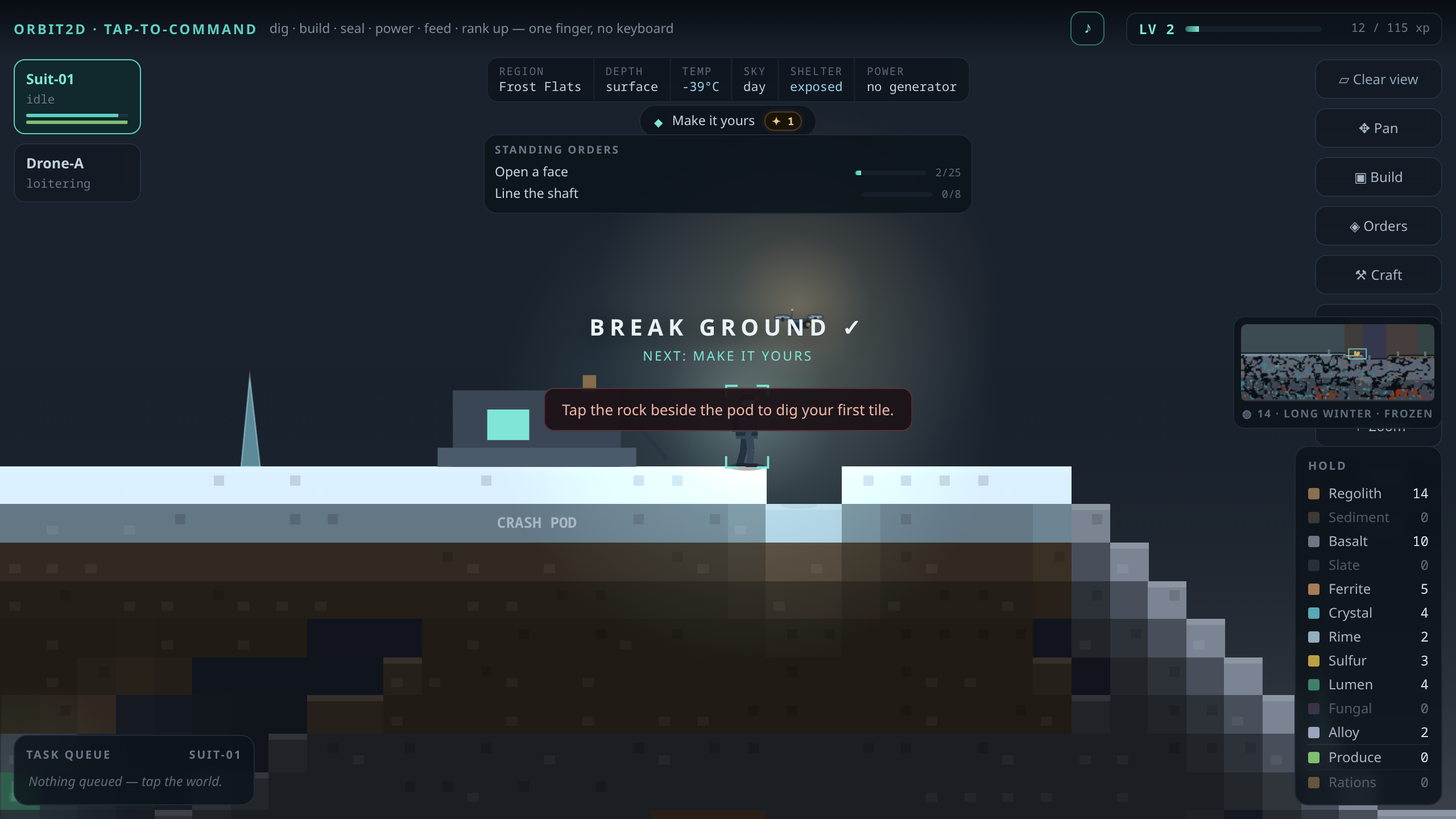
Long Winter is glacial, and it looks it: the ice shelf has grown to own most of the world, the
sky has gone cold and blue, the surface is white to the horizon and the readout says −39°C on a
region that would be ash flats anywhere else. It is not ash flats here. It is Frost Flats —
regions are renamed to match the world they are on, so what you read in the HUD is the place you are
actually standing in.
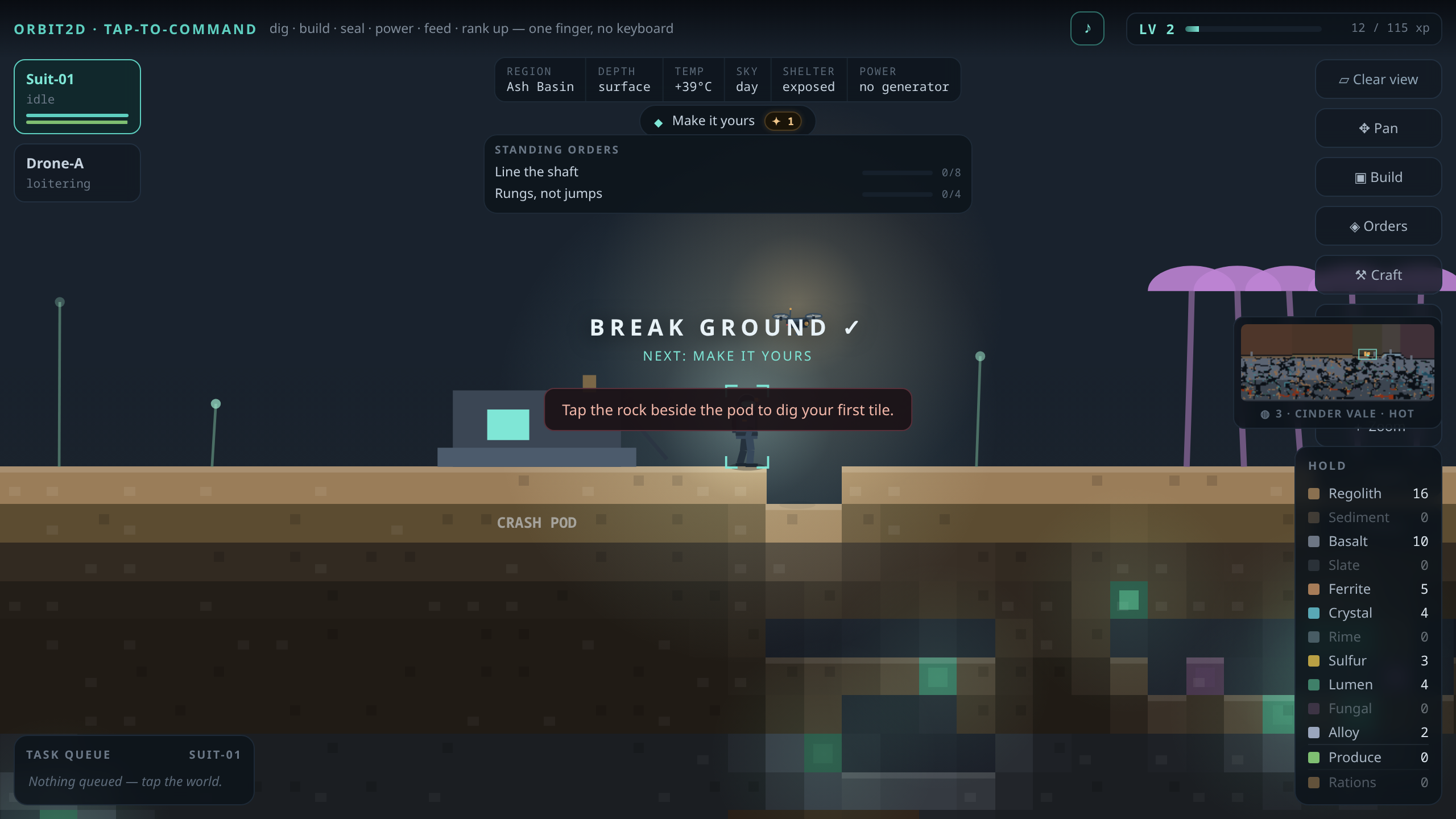
Cinder Vale is the same game and a completely different job. The ash flats dominate, the sky is
dust and orange, and the surface reads +39°C — a number Orbit2D had never shown
before. There is sulfur in nearly everything and essentially no rime, which quietly rewrites your
priorities: fuel is trivial, water-ice is a problem, and a heater is not the thing you build first.
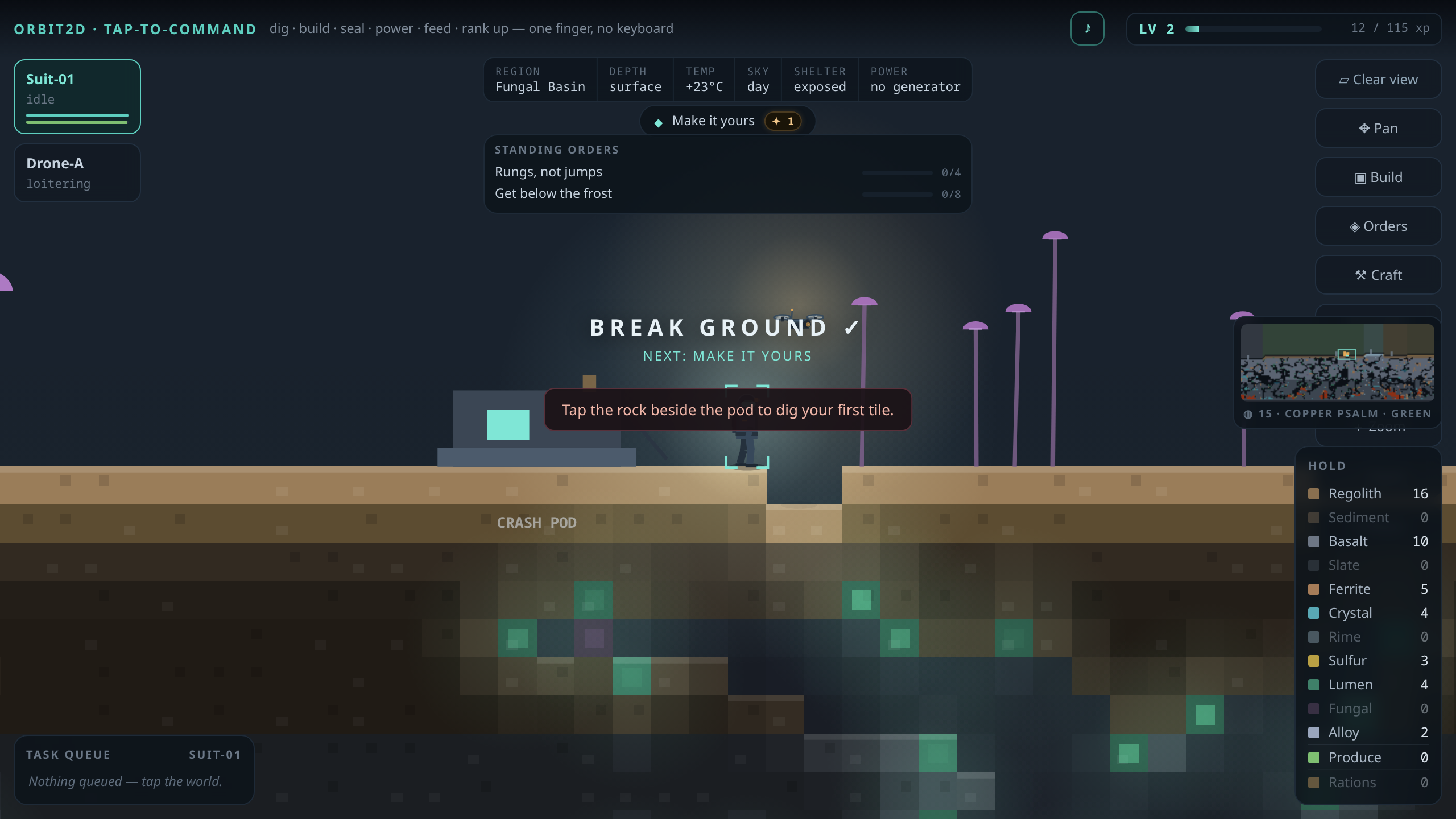
Copper Psalm is verdant, and it is the friendliest ground in the game: +23°C, a green sky, fungal
growth crowded along the whole surface instead of one basin, and lumen glowing through the rock
beneath your feet. Food and light are nearly free here. Alloy is not.
The differences are not cosmetic. Ore abundance is multiplied per climate, so a glacial world has
several times the rime of a volcanic one and a fraction of the sulfur; a crystalline world is where
you go for crystal and alloy; a verdant world is where you go for lumen and fungal. Surface materials
change, skies and haze are tinted, weather is overridden — a glacial world snows, an arid one blows
dust, a tempestuous one storms roughly twice as hard and twice as often — and the flora changes with
it, so nothing grows pink mushrooms on a rock at +39°C any more.
Chosen, not rolled
Each world’s climate is picked to suit its name rather than randomised. Long Winter is glacial.
Last Ember and Cinder Vale are volcanic. Glass Harrow and Bright Fault are crystalline. Rust Meridian
and Salt Lantern are arid. Hollow Tide storms. That means the twenty free worlds cover six of the
seven climates with none of them dominating the list, and a world’s character never changes — the
same name is always the same kind of place, which matters when a save has to regenerate its world
from a seed.
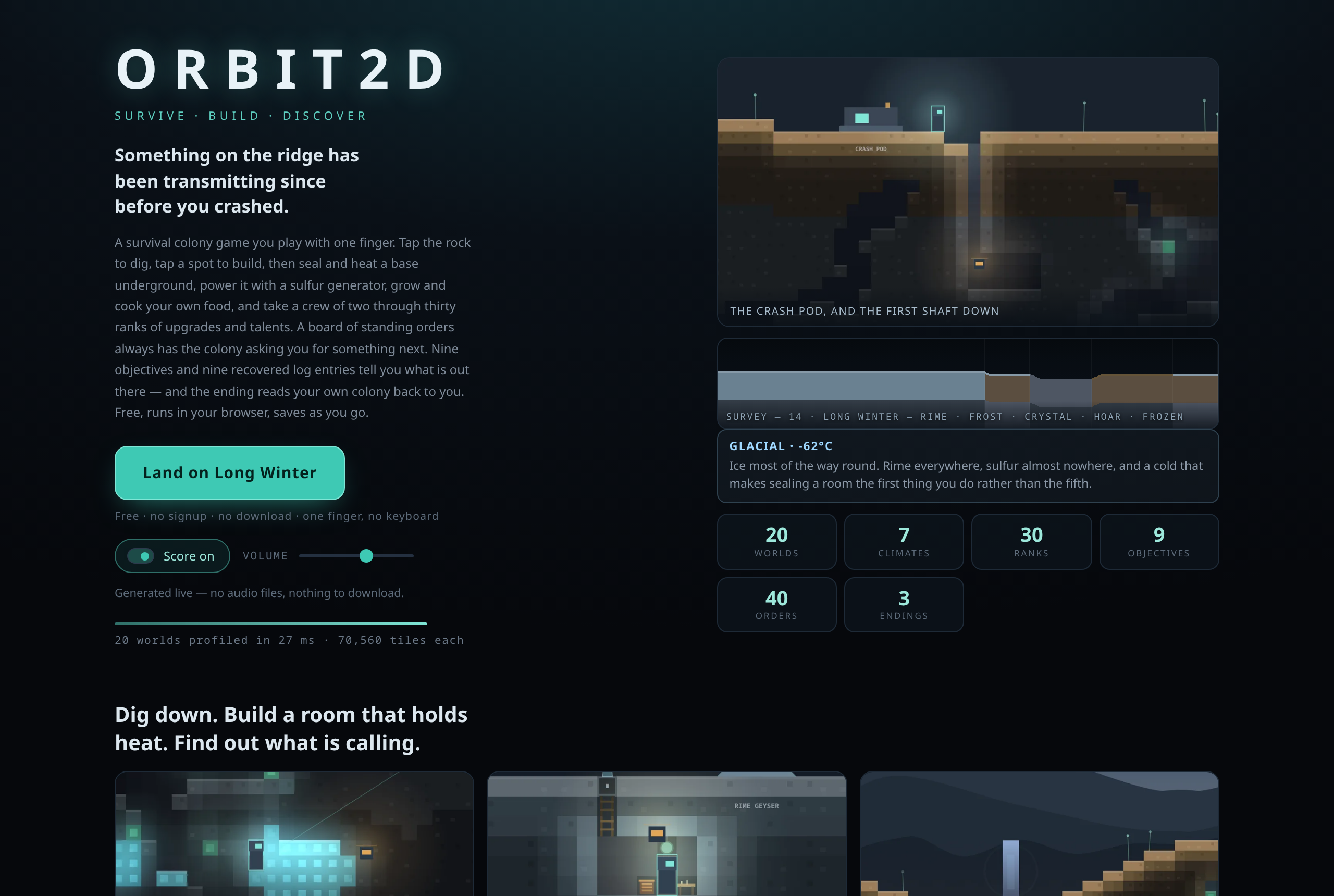
You can see all of it before you commit. Every card in the world grid now carries its climate, the
survey panel names it with the average surface temperature and a plain-language description of what
you are letting yourself in for, and the flight destination list shows it too — so choosing where to
fly is a decision about what kind of world you want next, not just a name you have not used yet.
World 1 is untouched
Verge is Temperate with no modifiers at all — the same spans, the same temperatures, the same
ground, generating exactly as it did before climates existed. Twenty-nine regression checks cover
this release, and two of them exist purely to prove that world 1 has not moved and that a save made
before this version still loads from its original key. The save format is unchanged again.
Live now at orbit2d.co as v0.13.0, and in the Android build on
the download page. All twenty free worlds and all seven
climates stay free, as everything already in the game always will.
Leave a Reply